
From 1664 to 1665, the Great Legation was sent from Holland to Russia by scientist and traveler, Nicholas Witsen. In 1687, Witsen went on to publish the article, “Northern and Eastern Tataria,” in which he wrote, “The Ukhta river is one day’s walk from Pechora; the river is 18 miles from a trail, where there is a small space next to water where the black oil is emitted.”
In 1721, Gregory Cherepanov, an iron ore miner, discovered an oil well spring on the Ukhta river (the Nizhne-Sortymskoye oil field, which would become the Yaregsky structure). In response, Tsar Peter the Great ordered a field investigation and samples to be taken from the oil spring for analysis. Based on the findings, entrepreneur Fëdor Savelyevich Pryadunov received approval from the Berg Board to set up an oil refinery plant and oil trade on Ukhta river.
Pryadunov’s approval occurred on November 18, 1745, which is now considered to be the start of the oil industry in Russia—and it all began with the Yarega oil field.
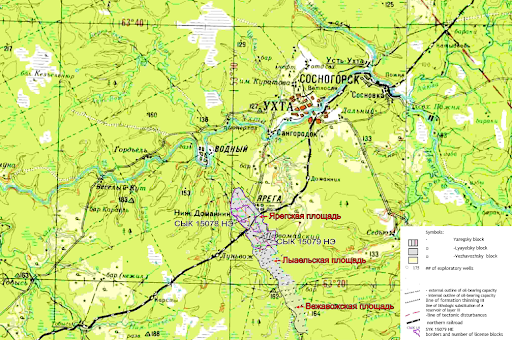
In 1932, I.N. Strizhov, a prominent Soviet geologist, discovered the Yaregsky field of high-viscosity oil in the Komi Republic, 20 kilometers from the Ukhta river.
The terrigenous seam of the Yaregsky Oil Field is 200 meters deep and is characterized by a high permeability of 2-3 um2 and a high oil saturation of 0,87 with a porosity of 0,26.
A distinctive feature of this particular oil field is its high oil viscosity, with an initial seam temperature of 6 0С or 16000 MPas.f.
The oil is heavy, and its density is under formative conditions of 933 kg/m3, and under standard conditions of 945 kg/m3. The gas-oil ratio is 10 to 13 m3/t, and the deposit is spread by a powerful water-bearing horizon of up to 80 meters.
The layer is also cracked and porous. The distance between vertical cracks can be 20 to 25 meters, and the opening of cracks varies from millimeter fractions of up to 2 to 3 centimeters.